The SASSA medical assessment explained
On this page (6 sections)
Three grants require a medical assessment: Disability, Care Dependency and Grant-in-Aid. A doctor appointed by the state — not your own doctor — assesses you, free of charge. The question is not what your diagnosis is but what you can still do: whether the condition prevents you working (or, for a child, requires full-time care). The assessment must be no older than 3 months at the date of application, and it determines whether an award is temporary (6–12 months) or permanent (longer than 12 months).
What the doctor is actually deciding
The assessment answers a narrow question set by the Social Assistance Act: does a physical or mental condition make you unfit to support yourself through work for longer than six months? Two people with the same diagnosis can receive different outcomes, because the test is about functional capacity, not the condition's name. For a child, the question is whether the disability is severe enough to require permanent care or support services beyond what a child of that age normally needs.
| Grant | The question the assessment answers |
|---|---|
| Disability Grant | Does the condition make you unable to work for 6 months or longer? |
| Care Dependency Grant | Does the child's severe disability require permanent full-time care? |
| Grant-in-Aid | Do you need full-time care from another person in daily life? |
How to prepare
- Gather every medical record you hold
Hospital discharge summaries, specialist letters, clinic cards, scan and X-ray reports, treatment and medication records, and your treating doctor's own report. Bring the originals.
- Write down what you can no longer do
Not symptoms — tasks. How far you can walk, whether you can stand for a shift, lift, concentrate, manage stairs, dress yourself, work a full day. Assessments are brief, and this is what the doctor must record.
- Bring someone who sees you daily
For mental-health and cognitive conditions especially, a family member's account of a normal week is evidence you cannot easily give about yourself.
- Describe your worst days honestly
People routinely understate difficulty out of pride. Describe the bad days as accurately as the good ones — the assessment is a snapshot, and it is the only one you get.
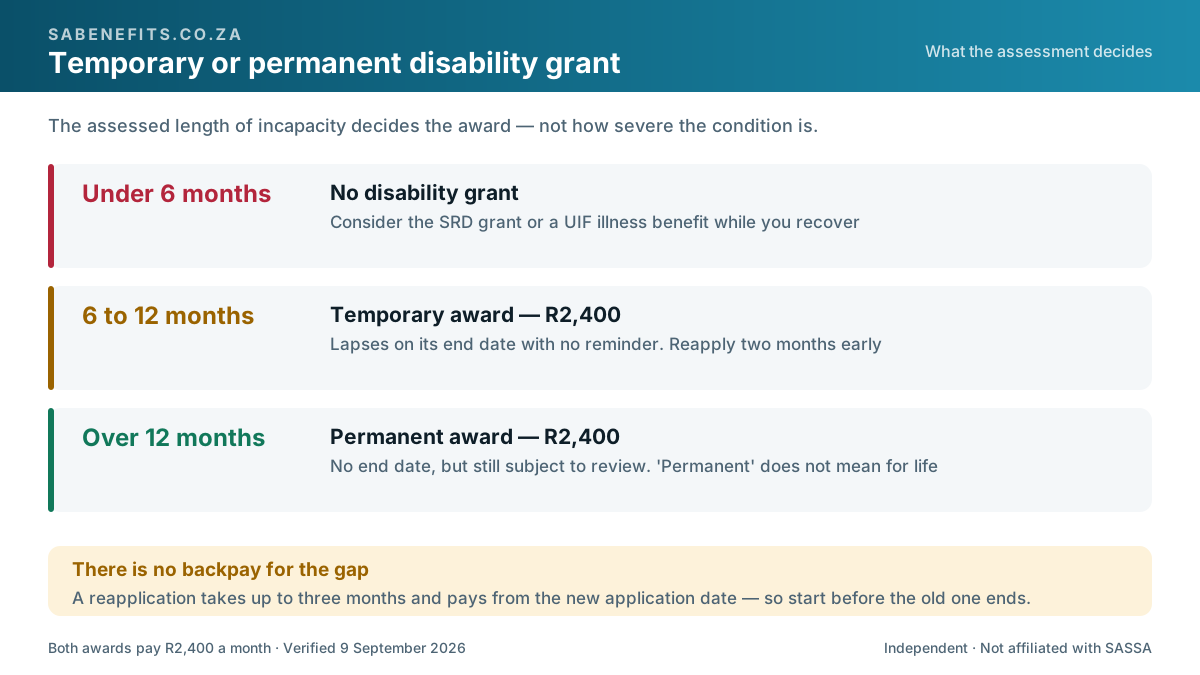
Temporary or permanent — how the outcome is decided
| Assessed duration of incapacity | Award | What follows |
|---|---|---|
| Less than 6 months | No disability grant | Consider the SRD grant or a UIF illness claim while you recover |
| 6 to 12 months | Temporary disability grant | The grant lapses on its end date — reapply with a fresh assessment if you are still unable to work |
| Longer than 12 months | Permanent disability grant | Continues without an end date, but remains subject to periodic review |
If the assessment goes against you
- Get the reason in writing. You cannot answer a finding you have not seen.
- Collect the records the assessment did not have — specialist reports carry particular weight.
- Appeal within 90 days, attaching those records. Medical appeals succeed more often than any other category, because the assessment is a single short encounter and your file is years long.
- Meanwhile, claim what you can. The SRD grant is available while you are unemployed, and a UIF illness benefit may apply if you were formally employed.
Frequently asked questions
Can I use my own doctor's report instead?
No — the assessment must be done by a doctor appointed by the state. Your doctor's report is important supporting evidence and you should bring it, but it does not replace the assessment.
How long is a SASSA medical assessment valid?
Three months from the date of the assessment. If your application is delayed past that, the assessment has to be redone.
Do I have to pay for it?
No. SASSA arranges and pays for the assessment.
How long does the assessment take?
The consultation itself is usually short. Waiting for a slot is the slow part, which is why disability applications often run to the full three-month processing window.
Does an HIV diagnosis qualify for a disability grant?
Not on its own. As with every condition, the test is functional: whether the illness currently prevents you from working for six months or more. Effective treatment that restores your capacity to work generally ends eligibility.
Will I be re-assessed later?
A temporary award ends on its date and requires a new assessment if you reapply. Permanent awards do not expire, but SASSA can call you for a review, which may include a fresh assessment.
Verified information
- Responsible body
- South African Social Security Agency (SASSA)
- Official source
- sassa.gov.za
- Status
- Officially confirmed
- Date verified
- Confidence
- High confidence
Assessment rules, the six-to-twelve-month temporary award band and the three-month validity of an assessment are confirmed against SASSA and gov.za guidance for the Disability Grant.
SA Benefits is independent and not affiliated with SASSA or government. Editorial guidance on this page is clearly separated from official information — see how we verify.
What's changed on this page (1)
Published covering the state-appointed doctor's role, the functional test applied, the three-month validity window and how the assessment determines a temporary versus permanent award.
Site-wide corrections are logged publicly in the corrections register.
Was this page helpful?
Your answer stays in your browser — we don't collect anything. It helps us decide what to fix and write next.