Care Dependency Grant 2026: R2,400 for a child needing full-time care
On this page (7 sections)
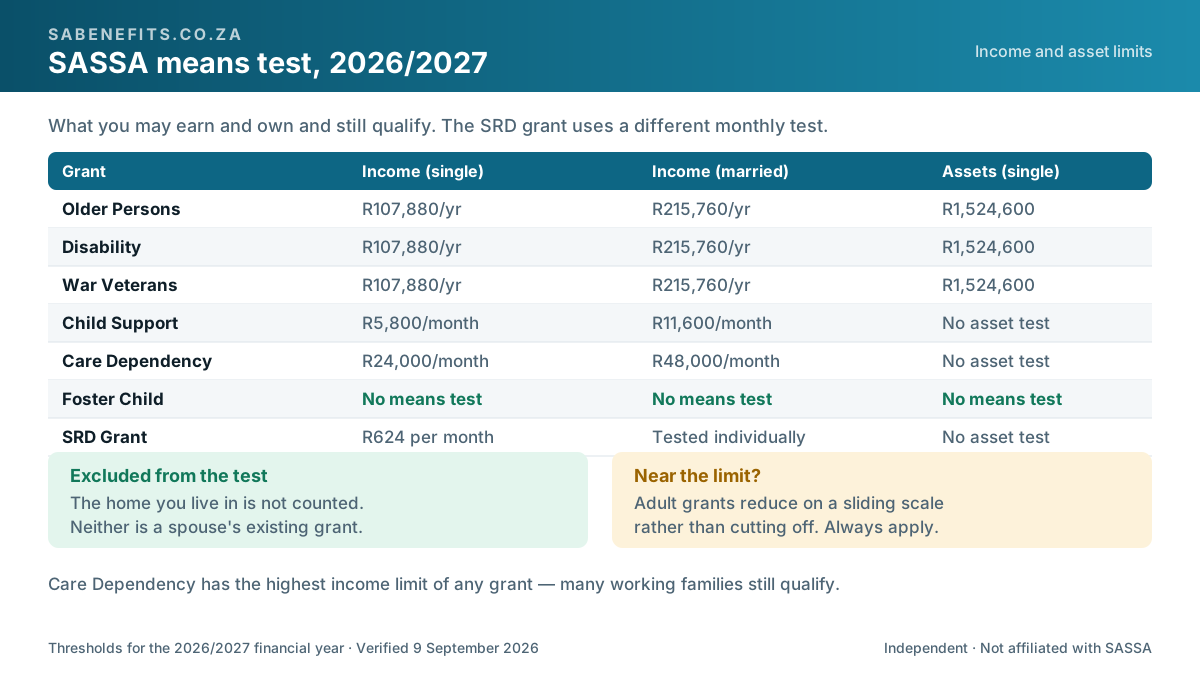
The Care Dependency Grant pays R2,400 a month — four times the Child Support Grant — to the parent, guardian, foster parent or custodian of a child under 18 with a severe physical or mental disability requiring permanent full-time care. A medical assessment confirms the disability. The income threshold is far higher than for other child grants: R24,000 a month single, R48,000 married, which means many working families qualify without ever realising it.
Who qualifies
| Requirement | Detail |
|---|---|
| The child | Under 18, with a severe physical or mental disability requiring permanent full-time care |
| You | Parent, guardian, foster parent or custodian, legally responsible for the child |
| Status | You and the child are SA citizens, permanent residents or recognised refugees, living in South Africa |
| Medical | A medical assessment confirming the severity of the disability |
| Income | Under R24,000 a month single (R288,000/year); R48,000 married (R576,000/year) |
| Assets | No asset test |
| Institutional care | Not payable if the child is permanently cared for in a state institution |
What 'severe disability' means here
The assessment asks whether the child needs permanent care or support services beyond what a child of that age would ordinarily need. As with the Disability Grant, the test is functional rather than diagnostic: two children with the same condition can receive different outcomes depending on the level of care each actually requires. Bring every report you have — paediatric, therapy, school-support and hospital records all speak to the level of care.
Documents
- Your 13-digit bar-coded ID and the child's birth certificate.
- A medical assessment report confirming the child's disability, no older than three months.
- All the child's medical records — hospital, specialist, therapy and school-support reports.
- Proof of marital status, three months' bank statements and proof of income.
- If the child is fostered, the court order as proof of custodianship.
Care Dependency or Child Support?
| Care Dependency | Child Support | |
|---|---|---|
| Amount | R2,400 | R580 |
| Requires a medical assessment | Yes | No |
| Income limit (single) | R24,000/month | R5,800/month |
| For | Children with severe disabilities | Any child under 18 |
| Both for the same child? | No — Care Dependency replaces CSG for that child | — |
When it ends
The grant lapses when the child turns 18. If the young adult remains unable to work because of the disability, apply for a Disability Grant in their own name — start about two months before the 18th birthday, because a fresh application takes up to three months and there is no backpay for the gap. The grant also ends if the child is placed permanently in a state institution, or if a review finds the circumstances have changed.
Frequently asked questions
How much is the Care Dependency Grant in 2026?
R2,400 a month from 1 April 2026, up from R2,320 — the same amount as the Disability and Older Persons grants.
Can I get the Care Dependency Grant and the Child Support Grant?
Not for the same child — Care Dependency replaces CSG for that child. You can claim CSG for your other children at the same time.
I work full-time. Can I still claim?
Very likely. The single-caregiver income limit is R24,000 a month, far above the Child Support Grant threshold. Apply and let the means test decide.
Does the child need to be my biological child?
No. Parents, guardians, foster parents and custodians can all claim, provided you are legally responsible for the child.
What happens when my child turns 18?
The grant lapses. Apply for a Disability Grant in the young adult's own name, starting about two months early to avoid an unpaid gap.
Is there an asset test?
No. Income only.
Verified information
- Responsible body
- South African Social Security Agency (SASSA)
- Official source
- sassa.gov.za
- Status
- Officially confirmed
- Date verified
- Confidence
- High confidence
R2,400 confirmed as the amount in force since 1 April 2026. Eligibility and the assessment requirement are confirmed against SASSA and gov.za guidance; the income threshold is the 2026/2027 figure applied by SASSA.
SA Benefits is independent and not affiliated with SASSA or government. Editorial guidance on this page is clearly separated from official information — see how we verify.
What's changed on this page (1)
Published with the confirmed R2,400 amount and the far higher income threshold that lets many working families qualify without realising it.
Site-wide corrections are logged publicly in the corrections register.
Was this page helpful?
Your answer stays in your browser — we don't collect anything. It helps us decide what to fix and write next.