Claiming the Child Support Grant when you're not the parent
On this page (8 sections)
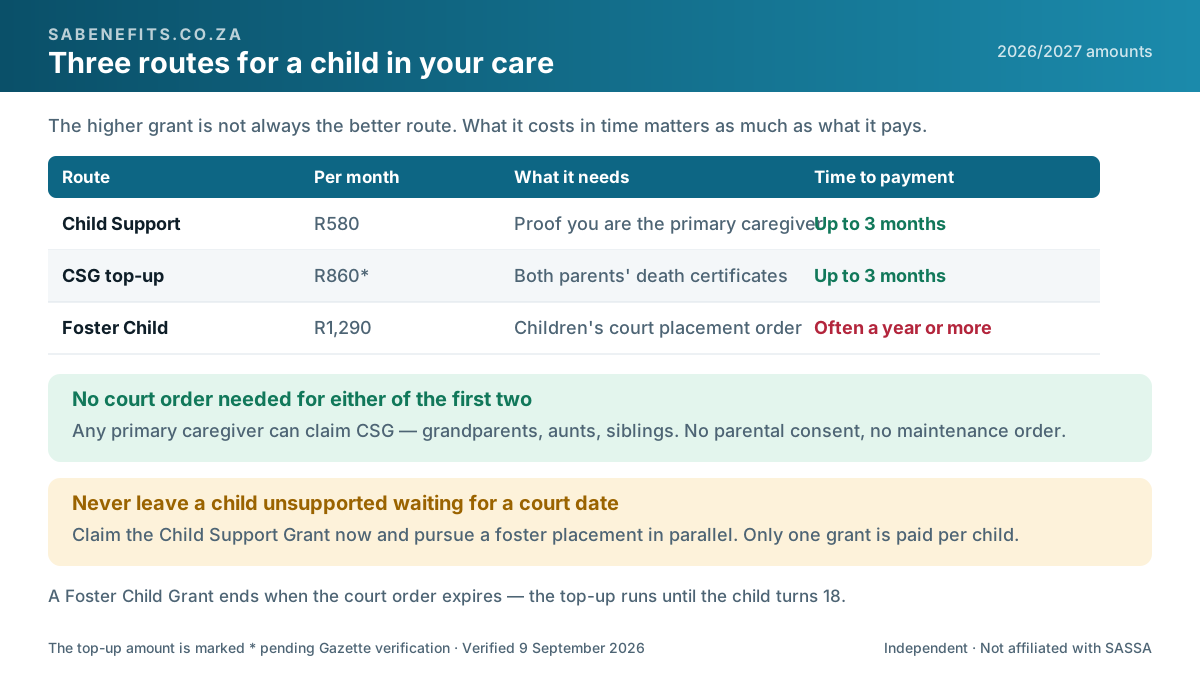
You do not need to be a child's parent to claim the Child Support Grant. The law pays it to the child's primary caregiver — the adult who actually takes day-to-day responsibility. Grandparents, aunts, uncles, older siblings, cousins and unrelated caregivers all qualify. No court order, no adoption, no maintenance order and no consent from the parents is required. What you must show is that the child lives with you and that you are the one caring for them.
What 'primary caregiver' means
A primary caregiver is the person who takes primary responsibility for the daily needs of the child: food, clothing, shelter, schooling, health care. The relationship is what counts, not the paperwork, and not the biology. You must be 18 or older, and you may not be paid to look after the child — a nanny or a childminder is not a primary caregiver.
Proof that works
| Evidence | Where to get it | Strength |
|---|---|---|
| School records naming you as the responsible adult | The child's school | Strong |
| Clinic card or Road to Health book showing you attend | The clinic | Strong |
| Affidavit from the school principal or a teacher | The school; commissioned at a police station | Strong |
| Affidavit from a social worker | DSD or an NGO social worker | Strong |
| Letter from a ward councillor or traditional leader | Your councillor or traditional authority | Good |
| Your own sworn affidavit setting out the arrangement | Any police station, free | Supporting — pair it with one of the above |
| The parents' death certificates, where they have died | Home Affairs | Also unlocks the top-up |
What you do not need
- A court order. That is the Foster Child Grant route, and it is not required here.
- Adoption. Adoption changes parentage permanently; the Child Support Grant does not ask for it.
- Consent from the parents. The grant follows the caregiving, not permission.
- A maintenance order, or any attempt to pursue the other parent first.
- The father's ID or details.
If the parents are alive but absent
This is the most common situation of all — a parent working in another province, or out of contact. You may claim as the caregiver. Where the parent previously received the grant for the same child, their grant must be stopped before yours starts, because only one grant is paid per child. Tell the officer at the interview; SASSA handles the transfer, and it is far quicker than it sounds.
If the parents have died
A relative caring for an orphaned child should claim the Child Support Grant top-up instead of the ordinary grant — R860* a month rather than R580, with the only extra requirement being the parents' death certificates. No court order, no social worker's report. Many families spend a year pursuing foster care for a payment they could have started within three months.
Child Support or foster care?
| Child Support Grant | Foster Child Grant | |
|---|---|---|
| Amount | R580 (R860* with the orphan top-up) | R1,290 |
| Court order | Not required | Required |
| Social worker's report | Not required | Required |
| Typical time to payment | Up to 3 months | Often a year or more |
| Renewal | Runs until the child turns 18 | Ends when the court order expires — must be extended |
| Means test | Income test on the caregiver | None |
Frequently asked questions
Can a grandmother get the Child Support Grant for her grandchild?
Yes, if she is the child's primary caregiver. No court order or parental consent is needed — proof that the child lives with her and that she cares for the child.
Can an older sibling claim for a younger brother or sister?
Yes, provided they are 18 or older and are genuinely the primary caregiver.
The mother still receives the grant but the child lives with me.
Report it at the SASSA office. Only one grant is paid per child, so hers must be stopped before yours begins. Take your proof of caregiving with you.
Do I need the parents' permission?
No. The grant follows who cares for the child.
What if I have no documents at all for the child?
Start at Home Affairs for the birth certificate, and apply to SASSA in parallel with an affidavit plus proof of the Home Affairs application. Applying early protects your backpay date.
Can a non-relative claim?
Yes. The test is primary caregiving, not blood relationship — as long as you are not being paid to care for the child.
Verified information
- Responsible body
- South African Social Security Agency (SASSA)
- Official source
- sassa.gov.za
- Status
- Officially confirmed
- Date verified
- Confidence
- High confidence
The primary-caregiver rule is confirmed against SASSA's Child Support Grant requirements and the gov.za service page.
SA Benefits is independent and not affiliated with SASSA or government. Editorial guidance on this page is clearly separated from official information — see how we verify.
What's changed on this page (1)
Published with the proof-of-caregiving options SASSA accepts, and the comparison against the foster care route for relatives.
Site-wide corrections are logged publicly in the corrections register.
Was this page helpful?
Your answer stays in your browser — we don't collect anything. It helps us decide what to fix and write next.