Foster Child Grant 2026: R1,290 a month, and the court order it needs
On this page (7 sections)
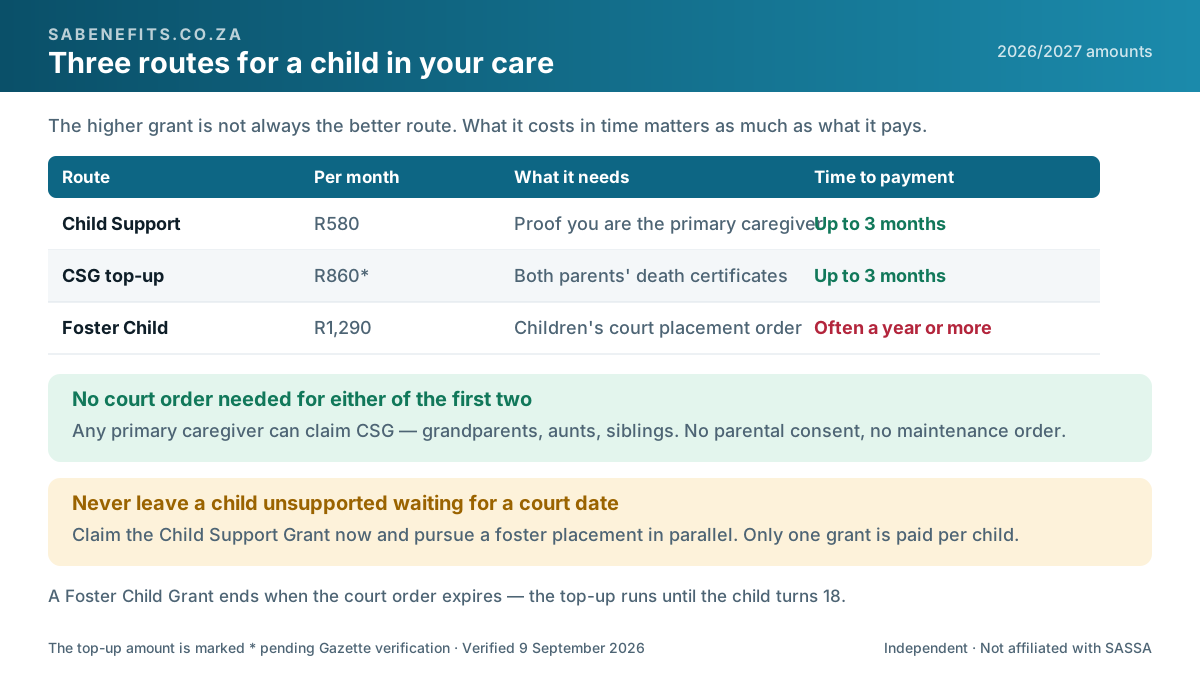
The Foster Child Grant pays R1,290 a month per foster child and has no means test at all — your income and assets are irrelevant. What it does require is a children's court order formally placing the child in your foster care, which needs a social worker's investigation and a court date. That process commonly takes a year or more. For a relative caring for an orphaned child, the CSG top-up pays R860* within about three months and needs no court at all.
Who qualifies
| Requirement | Detail |
|---|---|
| The child | Under 18 and placed in your foster care by a children's court order |
| You | The foster parent named in that order |
| Status | SA citizen, permanent resident or recognised refugee, living in South Africa |
| Means test | None — the only grant with no income or asset test |
| Where the child lives | With you, not in a state institution |
| Duration | Until the child turns 18, or until the court order expires |
Getting the order
- Report the child's situation to a social worker
At your local Department of Social Development office or a child-protection NGO. The social worker opens the case.
- The social worker investigates
They assess the child's circumstances, your household, and whether foster placement is in the child's best interests, then compile a report for the court.
- The children's court hears the matter
The presiding officer decides on the placement and issues the order, usually for a fixed period.
- Apply to SASSA with the order
Take the court order, the child's birth certificate and your ID to your SASSA office. The application process.
Detail on each stage, and what to do when it stalls: the foster care court order explained.
Documents
- The children's court placement order — the essential document.
- The child's birth certificate.
- Your 13-digit bar-coded ID or smart ID card.
- Proof of residence.
- The social worker's report, where the office asks for it.
No bank statements, no payslips, no proof of assets — there is no means test to satisfy. See documents you need for the substitutes where an ID or birth certificate is missing.
Foster Child Grant, CSG or the top-up?
| Foster Child | CSG top-up | Child Support | |
|---|---|---|---|
| Amount | R1,290 | R860* | R580 |
| Court order | Required | No | No |
| Social worker | Required | No | No |
| Means test | None | Income test | Income test |
| Time to payment | Often a year or more | Up to 3 months | Up to 3 months |
| Ends when | The order expires, or the child turns 18 | The child turns 18 | The child turns 18 |
| Best for | Children the state places in your care | Orphans with relatives | Any child in your care |
Keeping the grant
The single biggest risk to a Foster Child Grant is the order expiring. Payment stops when it does. The Children's Amendment Act 2022 lets presiding officers extend lapsed orders — for up to six months at a time — and treats an order as not terminated until the court extends or ends it, which has spared many families the loss. Do not rely on that: diarise the expiry date and start the extension early. Protecting the grant when an order lapses.
Frequently asked questions
How much is the Foster Child Grant in 2026?
R1,290 a month per foster child from 1 April 2026, up from R1,270.
Is there a means test for the Foster Child Grant?
No. It is the only SASSA grant with no income or asset test.
Can I get it without a court order?
No. The court order is what makes it a foster placement. Without one, claim the Child Support Grant — or, for an orphan in a relative's care, the top-up.
How long does the foster care process take?
Commonly a year or more, depending on social worker capacity and court rolls in your area.
Can I claim the Foster Child Grant and the Child Support Grant?
Not for the same child. You can hold a Foster Child Grant for one child and Child Support Grants for others in your care.
What happens when the child turns 18?
The grant ends. Where the young person is still in school, ask the social worker about extending the placement — the rules allow for it in defined circumstances.
Verified information
- Responsible body
- South African Social Security Agency (SASSA)
- Official source
- sassa.gov.za
- Status
- Officially confirmed
- Date verified
- Confidence
- High confidence
R1,290 confirmed as the amount in force since 1 April 2026. The court-order requirement and the absence of a means test are confirmed against SASSA and gov.za guidance on foster care.
SA Benefits is independent and not affiliated with SASSA or government. Editorial guidance on this page is clearly separated from official information — see how we verify.
What's changed on this page (1)
Published with the confirmed R1,290 amount and an honest comparison against the CSG top-up, which reaches most kinship carers far faster.
Site-wide corrections are logged publicly in the corrections register.
Was this page helpful?
Your answer stays in your browser — we don't collect anything. It helps us decide what to fix and write next.