Older Persons Grant 2026: R2,400 a month from 60
On this page (9 sections)
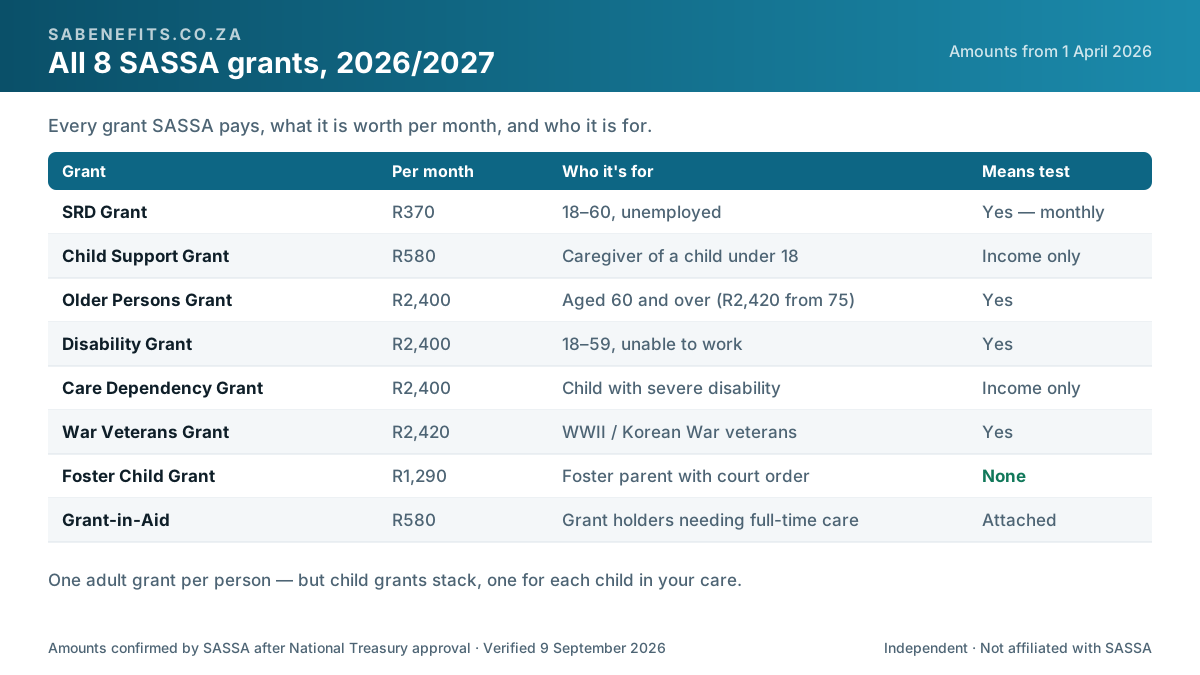
The Older Persons Grant — what most people call the state pension or old age grant — pays R2,400 a month from age 60, rising to R2,420 from 75. You qualify on age, citizenship and a means test on income and assets. Your work history is irrelevant: this is not a contributory pension, and never having been formally employed does not affect your claim. Apply in person at a SASSA office; processing takes up to three months and approval is backdated to your application date.
Do you qualify?
| Requirement | Detail |
|---|---|
| Age | 60 or older. The higher R2,420 rate starts at 75. |
| Status | South African citizen, permanent resident or recognised refugee |
| Residence | Living in South Africa at the time of application |
| Income | Under R107,880 a year if single; R215,760 if married |
| Assets | Under R1,524,600 if single; R3,049,200 if married — excluding your home |
| Other grants | You may not hold another grant in your own name, though Grant-in-Aid can be added |
| Institutional care | You may not be maintained in a state institution |
The means test, in plain terms
SASSA looks at your income (salary, private pension, rental income, annuities, maintenance, self-employment earnings) and your assets (property other than your home, investments, savings). A social grant is never counted as income — yours or your spouse's. If you are married, the test uses the couple's combined figures against the married thresholds, so a working spouse matters, but their grant does not. Full detail, including what is excluded: the SASSA means test.
| Single | Married | |
|---|---|---|
| Income limit | R107,880 a year (R8,990/month) | R215,760 a year (R17,980/month) |
| Asset limit | R1,524,600 | R3,049,200 |
| Home you live in | Excluded | Excluded |
| Spouse's social grant | n/a | Not counted as income |
What to take to the office
- Your 13-digit bar-coded ID or smart ID card — this proves your age, so no birth certificate is needed.
- Proof of marital status: marriage certificate, divorce decree or a spouse's death certificate.
- Three months' bank statements for every active account, including fixed deposits and investments.
- Proof of income: your latest payslip or private-pension statement, and your spouse's if you are married.
- Proof of assets, including the municipal valuation of any property you own.
- Proof of residence, and your UIF 'blue book' or discharge certificate if you were formally employed.
Missing something? Sworn affidavits substitute for most of these — see documents you need for the full substitution table. Do not delay applying to chase a document: your application date sets your backpay.
Applying
- Go to the SASSA office serving your home
In person only — there is no online application for permanent grants. Arrive early; offices are weekdays only.
- Complete the form with the officer
Only you or a SASSA official may fill in the form. The officer interviews you on income, assets and household circumstances.
- Keep your receipt
You must leave with a receipt showing your application number and date. That date is what your backpay is calculated from.
- Wait up to three months
The outcome comes by SMS or letter to the contact details SASSA holds — make sure your cellphone number is current before you leave the office.
When you are paid
The Older Persons Grant is paid first each month, on day one of the four-day payment run, with the War Veterans Grant alongside it. The exact calendar dates for every month to March 2027 are on the payment dates page. If your grant is under review you are paid on the fourth day instead. Money stays in the account until you withdraw it — there is nothing to gain by queueing at dawn.
Add Grant-in-Aid if you need daily care
If you cannot manage daily life without another person's help, Grant-in-Aid adds R580 a month to your Older Persons Grant — R2,980 in total. It needs a medical report confirming the need for full-time care, and it is added to the grant you already hold rather than claimed separately. It is one of the most under-claimed payments in the system.
Common reasons applications are declined
| Reason | What to do |
|---|---|
| Income above the threshold | If income has since ended, appeal with current bank statements and proof |
| Assets above the threshold | Check the valuation used — your home is excluded; appeal with the municipal valuation |
| Incomplete documents | Return with the missing items or the affidavits that replace them |
| Married-couple income | If separated or divorced, provide the proof — the married thresholds should not apply to you |
| Already receiving another grant | Only one adult grant is payable; the higher-value grant is normally the one to keep |
Frequently asked questions
How much is the old age pension in South Africa in 2026?
R2,400 a month from age 60, and R2,420 a month from 75, both effective from 1 April 2026.
At what age do you get the Older Persons Grant?
60. The qualifying age was equalised for men and women years ago — it is 60 for everyone.
Do I need to have worked to get it?
No. It is a social grant funded from tax, not a contributory pension. Work history is irrelevant to your claim.
Will owning my house disqualify me?
No. The home you live in is excluded from the asset test. Other property counts.
Can my husband and I both receive it?
Yes, if you both qualify. Each grant is individual, and neither grant counts as the other's income.
Can I get the Older Persons Grant and a Disability Grant?
No — one adult grant per person. From 60 the Older Persons Grant usually replaces a Disability Grant automatically.
Does a private pension stop me qualifying?
Only if it pushes your income over the threshold. A modest private pension often still leaves you eligible, so apply rather than assume.
Verified information
- Responsible body
- South African Social Security Agency (SASSA)
- Official source
- sassa.gov.za
- Status
- Officially confirmed
- Date verified
- Confidence
- High confidence
Amounts confirmed as the figures in force since 1 April 2026. Eligibility, means-test thresholds and document requirements confirmed against SASSA and gov.za guidance.
SA Benefits is independent and not affiliated with SASSA or government. Editorial guidance on this page is clearly separated from official information — see how we verify.
What's changed on this page (1)
Published with the confirmed 2026/2027 amounts (R2,400, rising to R2,420 at 75), the full means test including the two exclusions most applicants do not know about, and the reasons applications are declined.
Site-wide corrections are logged publicly in the corrections register.
Was this page helpful?
Your answer stays in your browser — we don't collect anything. It helps us decide what to fix and write next.